

Unique Yellow Spring Flowering Shrubs: More than Forsythia
Forsythia in the landscape
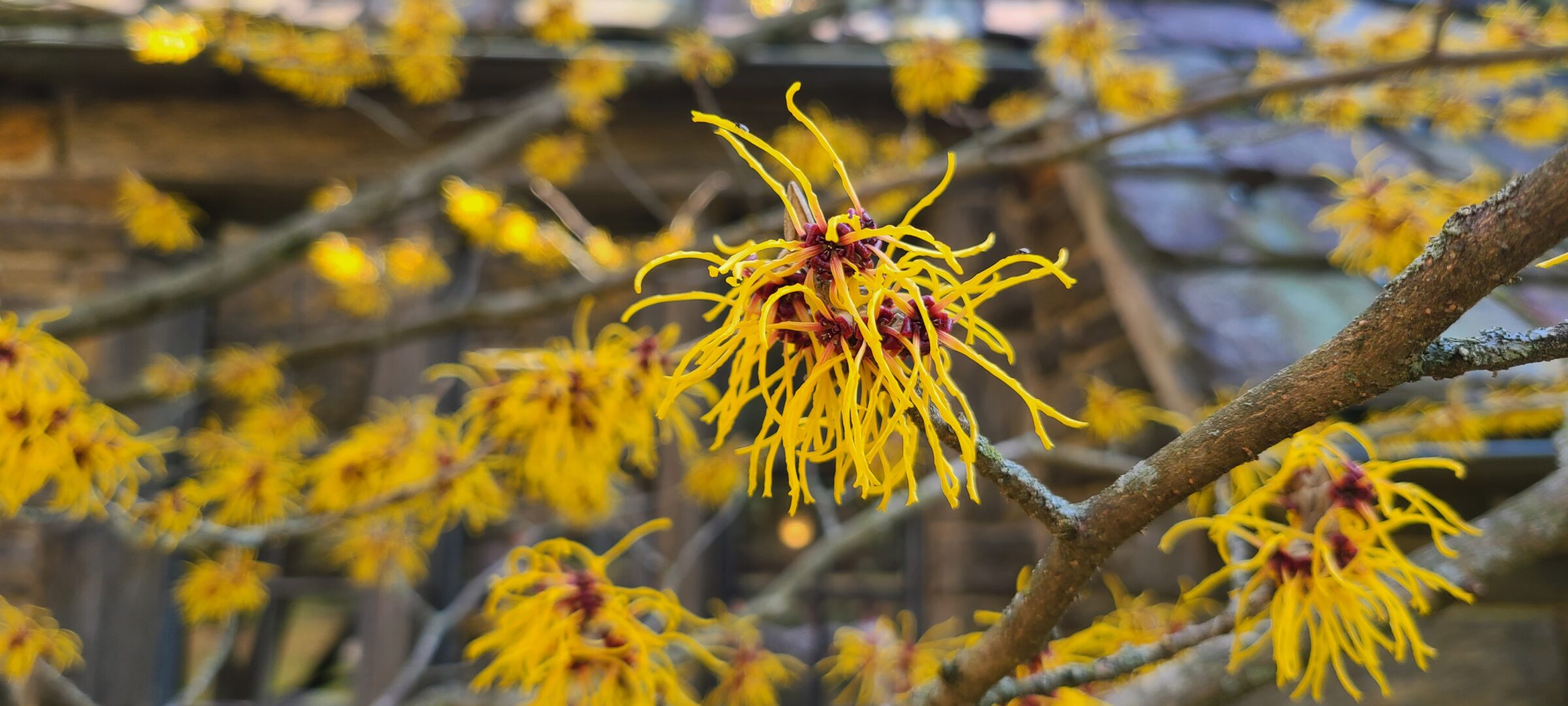
During the early Spring in the many parts of the North Eastern United States you may have noticed an explosion of yellow in the landscape. We can attribute this cheerful signal of Spring to a very popular plant used extensively in the landscape, Forsythia. The bright yellow blooms of Forsythia and other yellow spring flowering shrubs, along with the high pitched singing of the vernal ponds, and the unfurling of leaf puppies, are all quintessential signs of Spring. Here in Southeastern PA, in zone 7a, Forsythia typically begin to bloom the last week of March and continue for several weeks. Their popularity amongst home gardeners is certainly warranted as these plants are tough and resilient. Deer tend to leave them alone, they are tolerant of most growing conditions, and their rapid growth creates almost instant hedges.
Another reason to plant these in your landscape is that they are an excellent source of phenology, or natures calendar. Peak bloom of this four-petaled yellow flowering shrub is a signal that soil temperatures are approaching 55 degrees Fahrenheit. This important indicator signals that crabgrass is ready to start germinating and it is time to apply pre-emergent herbicides to your lawn. In addition, Forsythia bloom stages are key phenological indicators for monitoring Annual Bluegrass Weevil (ABW) activity in turfgrass. When forsythia is in full bloom, adult weevils begin moving from overwintering sites to turf. When forsythia reaches the half gold and half-green stage, it signals peak adult migration, making it the ideal time for monitoring and control. While my hedge of Forysthia is blooming its head off, I do not use it to time any lawn herbicide applications as my lawn at home is currently a carpet of Celandine (Ficaria verna).
While it has its merits and a purpose in the landscape, here is the thing though. Forsythia are one of those plants that has been peddled to gardeners for decades and I would like to bring awareness to other more obscure plants that serve a similar purpose. The following list of plants are a bit harder to find in the nursery trade, and perhaps the onus is on the growers to make these plants more widely available before they replace the boring Forsythia as the predominant yellow flowering shrubs. I should also state that I realize the following plant suggestions have different cultural requirements and applications in the landscape and are not meant to replace Forsythia. However, they are meant to give you options for choosing yellow flowering shrubs and small trees that signal that start of Spring.

1. Winter Hazel
The Winter Hazel genus (Corylopsis) is on the top of my list for favorite alternatives to Forsythia. This genus is comprised of 30 different species belonging to the Witch hazel family. Several of these species have become staples in public gardens and arboreta, and for good reason. They are comparable to Forsythia only with their late March and early April blooms. Upon closer inspection, these plants are far more interesting and will garner envy from your neighbors. I will describe several Winter Hazel species that have stood out to me and which are more easily found in the nursery trade.
Spike Winter-Hazel – Corylopsis spicata
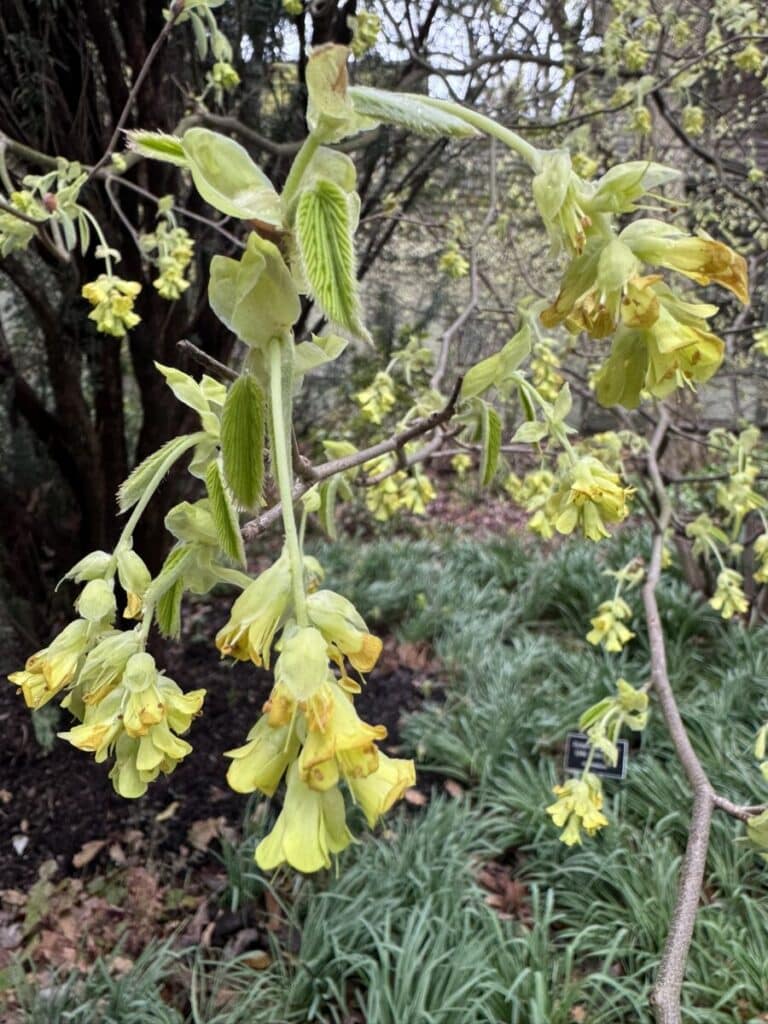
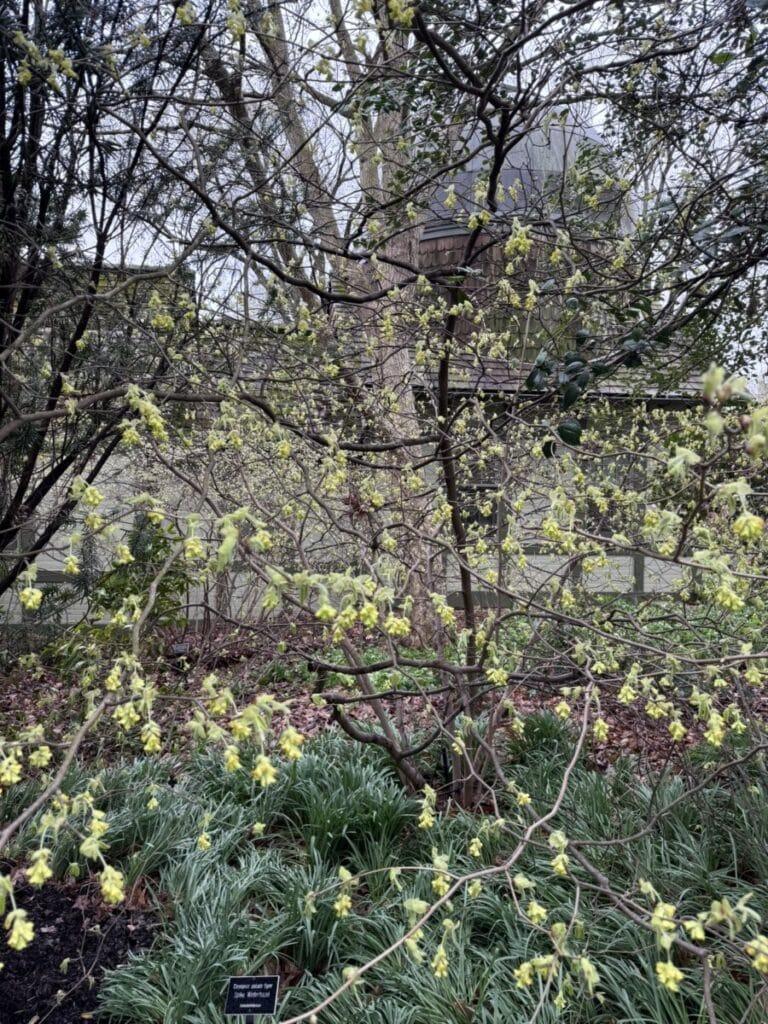
Spike Winter hazel has a more modest flower color than Forsythia. Where Forsythia wows you with a profusion of deep yellow, Corylopsis spicata flower color is more muted and settle. For those who prefer a less jarring spring awaking, the Spike Winter Hazel is an excellent choice. A popular cultivar and one which is represented at the Scott Arboretum is ‘Ogon’. While the straight species is more forgiving of sunnier locations, Corylopsis spicata ‘Ogon’ favors part to full shade. This characteristic makes it an excellent choice to brighten up your shade garden in the early Spring days when not much else is blooming. This selection carries the torch in the dark corners of your shade garden well after the flowers have faded. ‘Ogon’ has gorgeous chartreuse foliage that adds an that extra design benefit most gardeners look for.
When it comes to the flowers, both the cultivar selection and the straight species produce flowers that arrive in short, pendulous racemes — clusters of small, bell-shaped blooms that dangle from bare branches like tiny chandeliers. The color sits somewhere between pale butter and soft chartreuse, and when backlit by that low-angle March sun, the effect is nothing short of luminous. Unlike Forsythia, which screams at you from across the street, Spike Winter Hazel invites you to walk over and take a closer look. And when you do, you will catch a light, sweet fragrance — subtle enough that you might wonder if you imagined it.
Spike Winter Hazel matures at around six to eight feet with a graceful, spreading habit. It lacks the wild, arching canes that make an unpruned Forsythia look like it is having a bad hair day. Instead, C. spicata grows into a layered, almost architectural form that holds its own in the off-season. The foliage emerges with a slight bluish-green tint and the fall color, while not show-stopping, is a pleasant warm yellow. Culturally, this is where Spike Winter Hazel parts ways with Forsythia entirely — it prefers part shade and moist, acidic, well-drained soil. Think woodland edge, not the middle of your front yard in full sun.
Buttercup Winter-Hazel – Corylopsis pauciflora
A Winterhazel with a small stature and an appropriate common name of Buttercup. If C. spicata is the quiet conversationalist of the group, then C. pauciflora is the whisper. This is the smallest of the Winter Hazels I am highlighting here, topping out at around four to six feet tall and wide. It is a delicate plant in the best sense of the word — fine-textured branches, dainty leaves, and flowers that appear in clusters of just two or three blooms per raceme. In fact, the species epithet pauciflora literally translates to “few-flowered,” and the botanists were not exaggerating.
What C. pauciflora lacks in floral abundance it compensates for with charm. The blooms are a warm, clear primrose yellow — the richest of the three Winter Hazels on this list — and they appear so early that a late frost can occasionally nip them. Each flower is tiny, but the color is saturated enough to register across the garden, especially against the dark bark of the still-bare stems. There is a faint fragrance here as well, though you will need to get your nose right up to the flowers to detect it.
Because of its compact size, Buttercup Winter Hazel is an outstanding choice for smaller residential gardens where a full-sized Forsythia would quickly outgrow its welcome. It is equally at home in a mixed border, tucked among hellebores and early bulbs, or used as a specimen at a garden entry where visitors can appreciate its subtlety up close. Like its Corylopsis cousins, it favors part shade and acidic soil with consistent moisture. If you are gardening on a small lot and want a yellow-flowering shrub that does not require annual hacking with hedge trimmers, this is your plant.
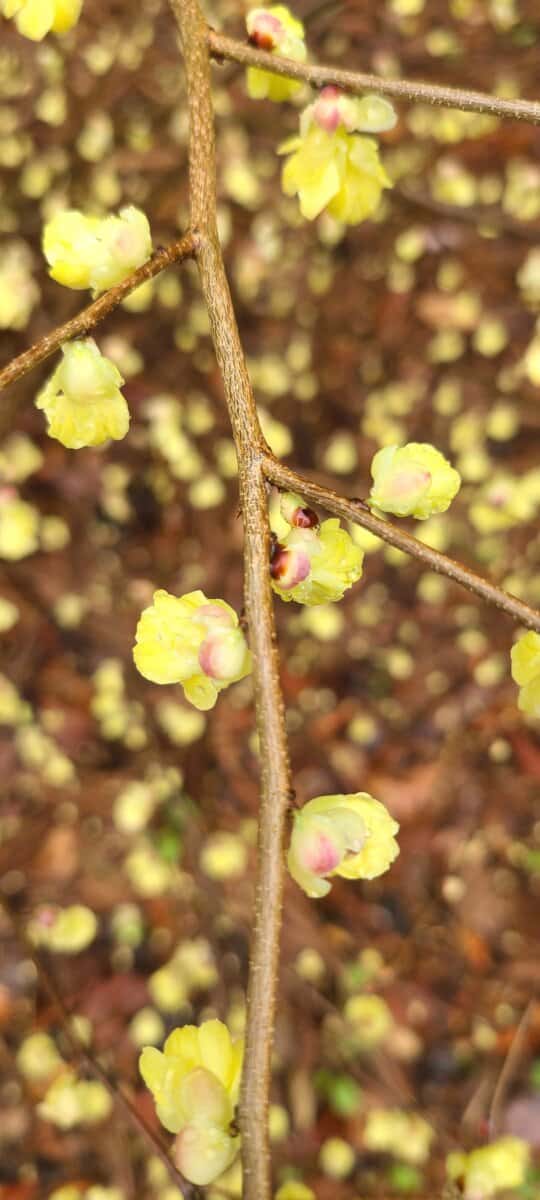
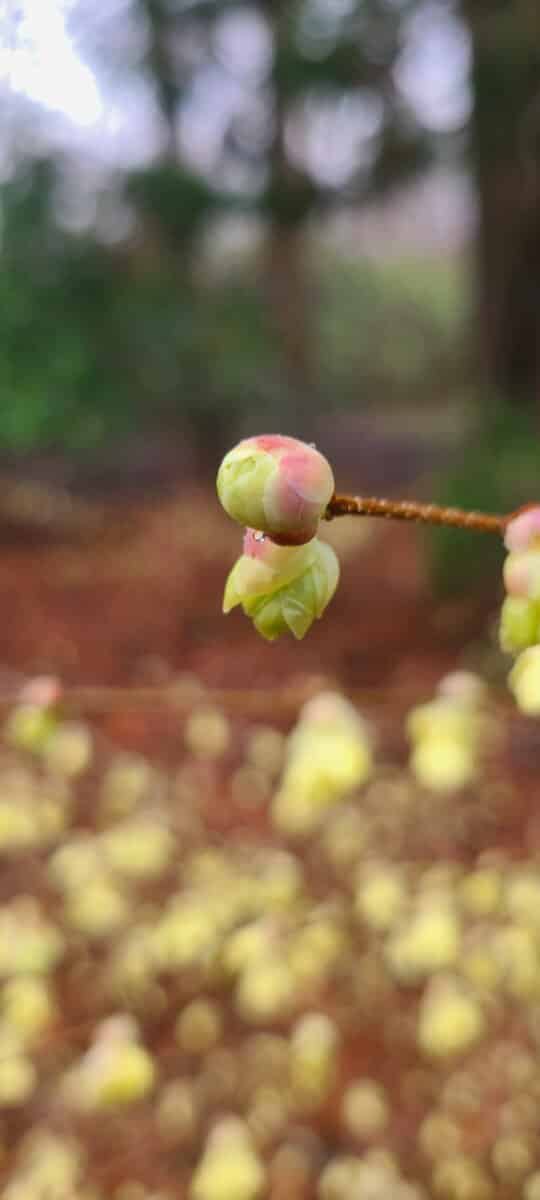
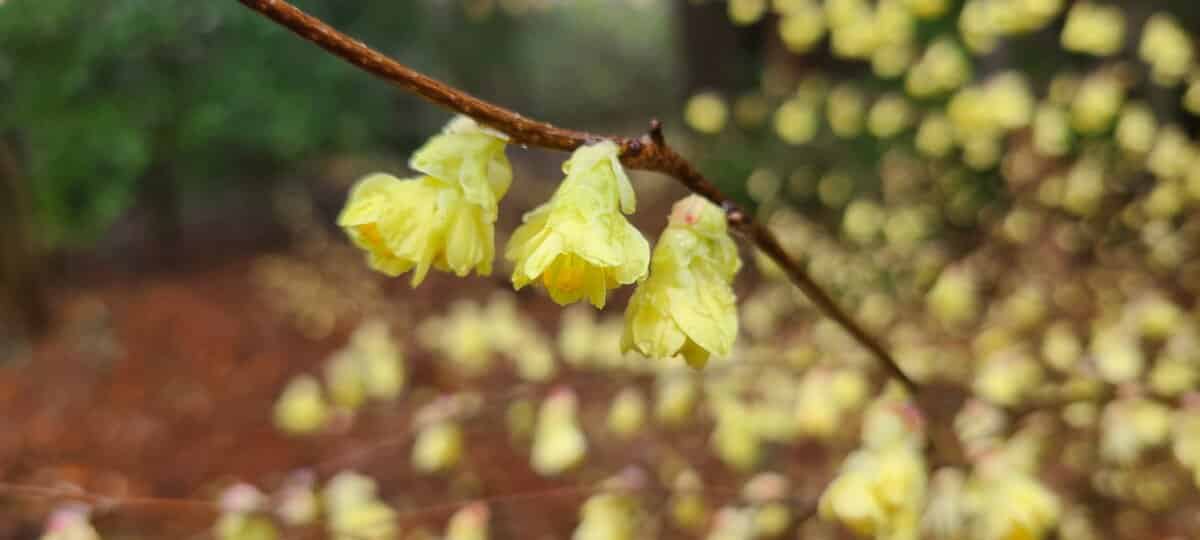
Fragrant Winter-Hazel – Corylopsis glabrescens
Fragrant Winter Hazel is the largest and, to my eye, the most visually striking of the three species I am recommending here. Where C. pauciflora is a whisper and C. spicata is a conversation, C. glabrescens is an announcement — though still delivered with more class than Forsythia could ever manage. Mature specimens can reach fifteen feet in height with a broad, spreading canopy, and when the plant is in full bloom in late March, the effect is spectacular.
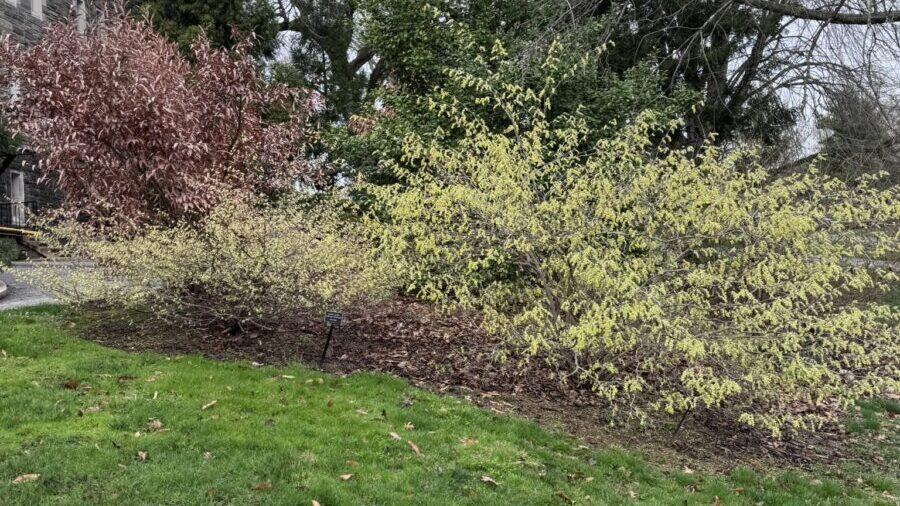
Once again though, I must recommend a superior cultivar to the straight species. Some plant nerds noticed an improved version of C. glabrescens during a 1995 plant trial at Longwood Gardens and aptly named it ‘Longwood Chimes’. This cultivar packs an even more intense aroma and an inflorescence that is typically 50% larger. To add to this, the Fragrant Winter Hazel ‘Longwood Chimes’ blooms longer and about one to two weeks later, ensuring any late frosts do not compromise the flowers. However, I took a peak at both the cultivar and the straight species on April 2nd, 2026 and although C. glabrescens flowers were fading, they both were still putting on a show at the Scott Arboretum in Swarthmore, PA.
Let’s discuss the flowers as they pertain to the straight species of this yellow spring flowering shrub. They are borne in longer, more densely packed racemes than either of the other two species, and the color is a soft, cool lemon yellow — lighter than C. pauciflora but brighter than C. spicata. Each raceme dangles three to four inches from the branch, and when the entire canopy is loaded with them, the plant looks as if it has been draped in pale yellow lace. The common name is well earned: the fragrance of C. glabrescens is the most noticeable of the three, a clean, sweet scent that carries on the spring air and will stop you in your tracks. If you have ever walked through a garden in early spring and caught a mysterious floral scent before you could identify its source, there is a fair chance a Fragrant Winter Hazel was nearby.
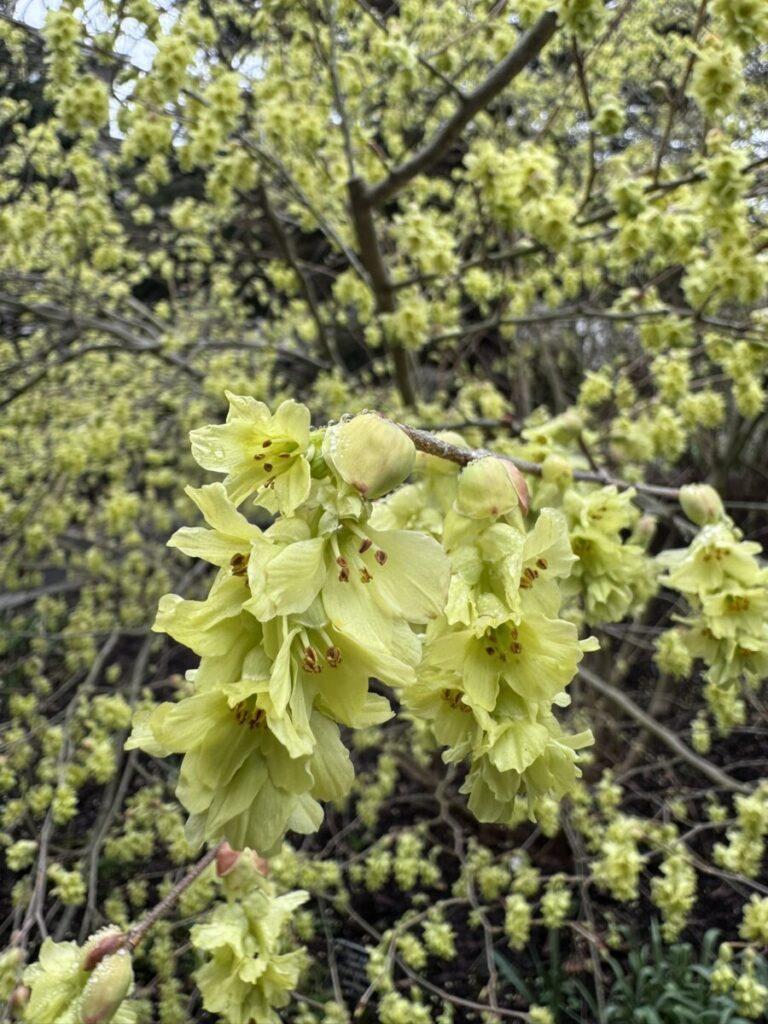
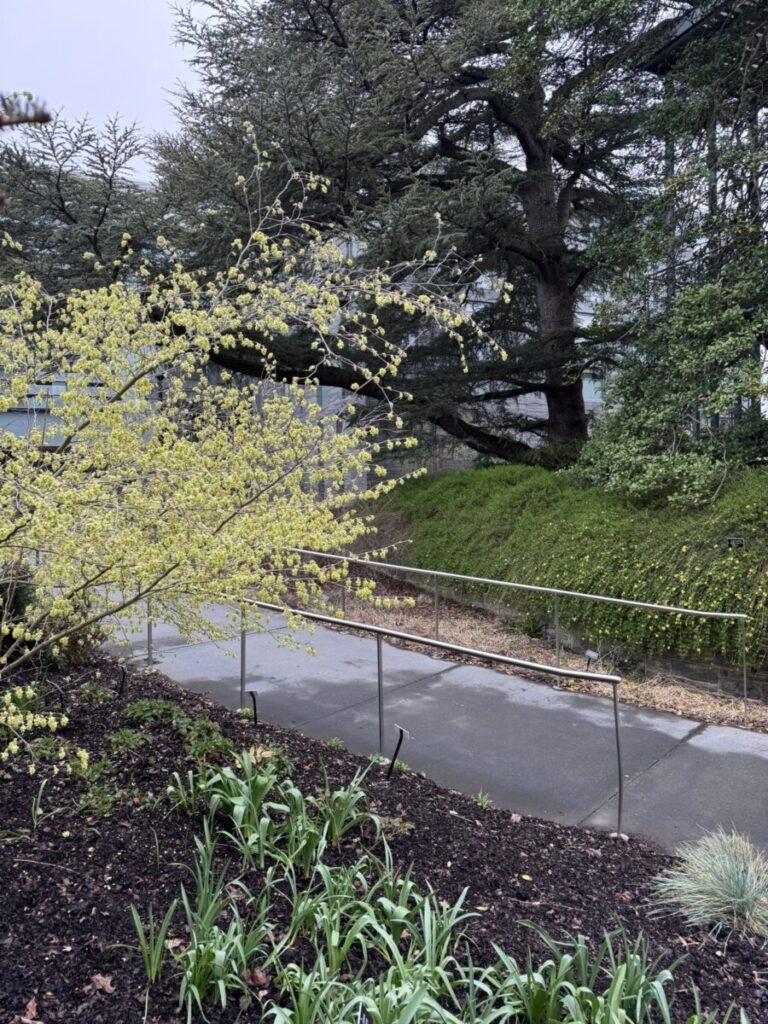
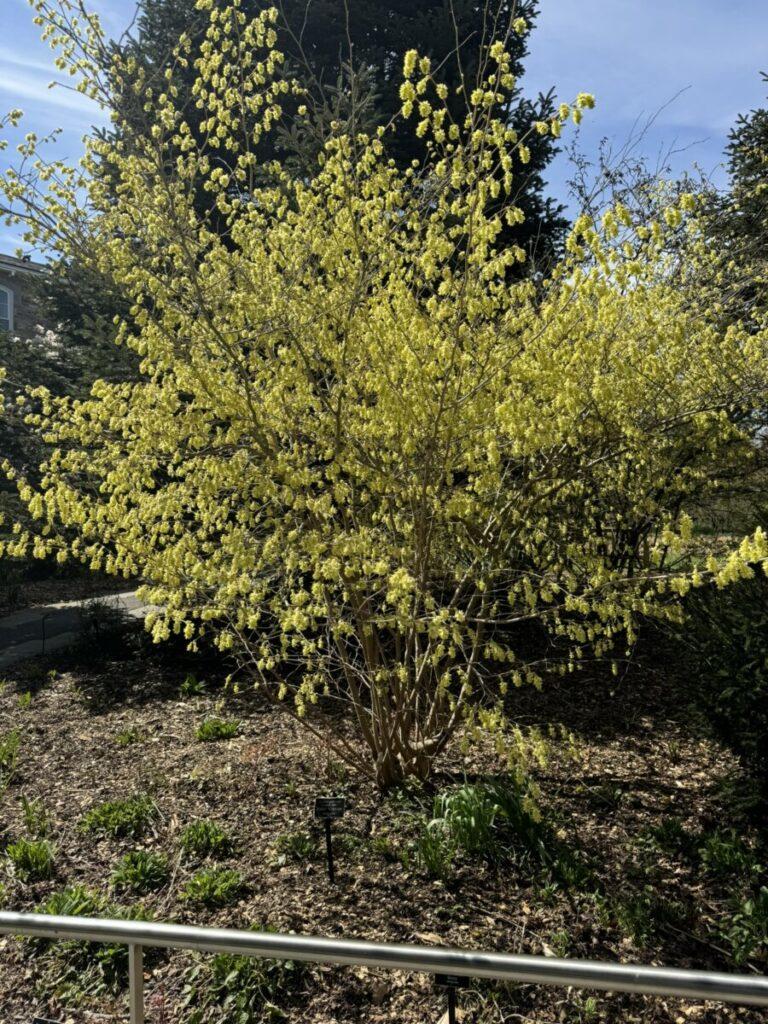
The larger stature of C. glabrescens makes it well-suited for use as a specimen tree or as a backdrop in a woodland garden. At the Scott Arboretum at Swarthmore College, where I have the privilege of observing these plants throughout the seasons, the mature specimens of Fragrant Winter Hazel are among the most admired plants on campus during their bloom period — and that is saying something on a campus loaded with world-class plant collections.
2. Leatherwood
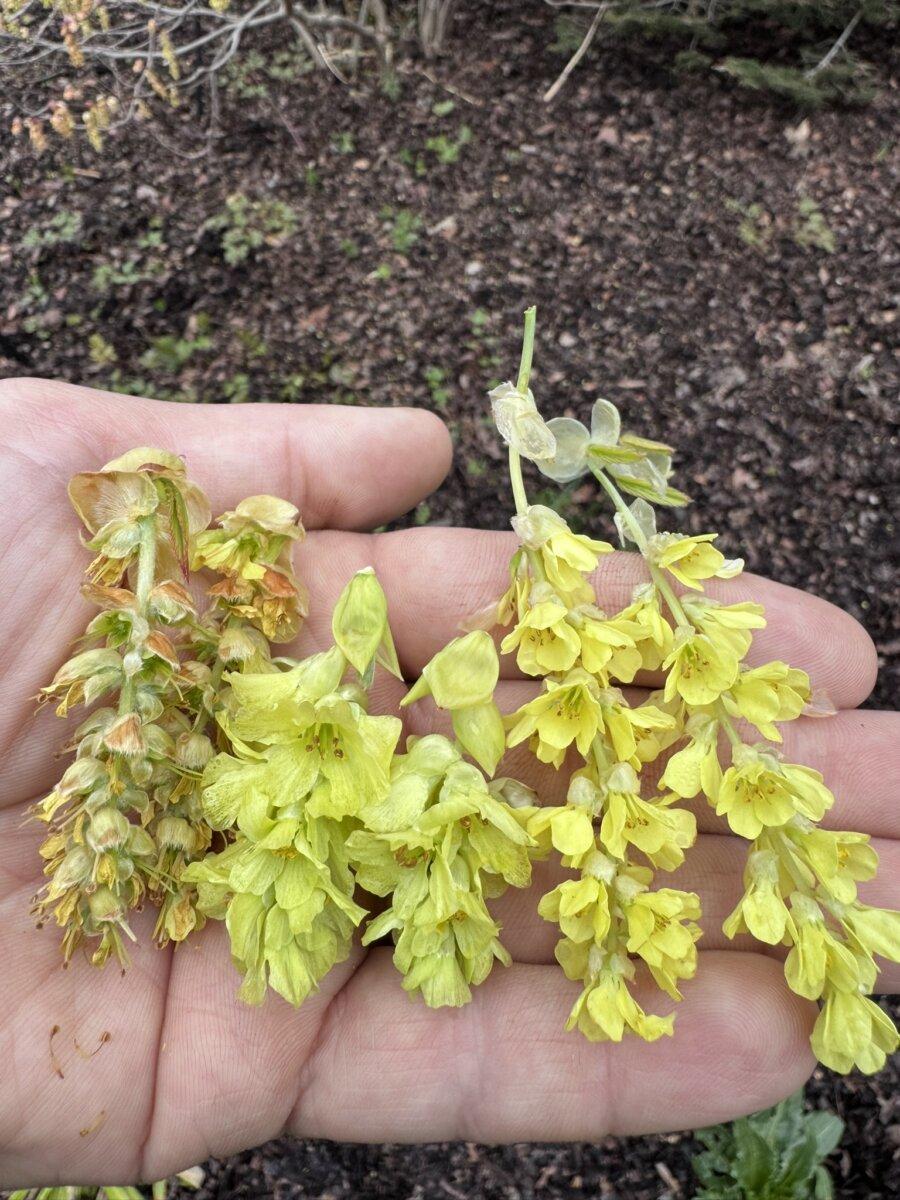
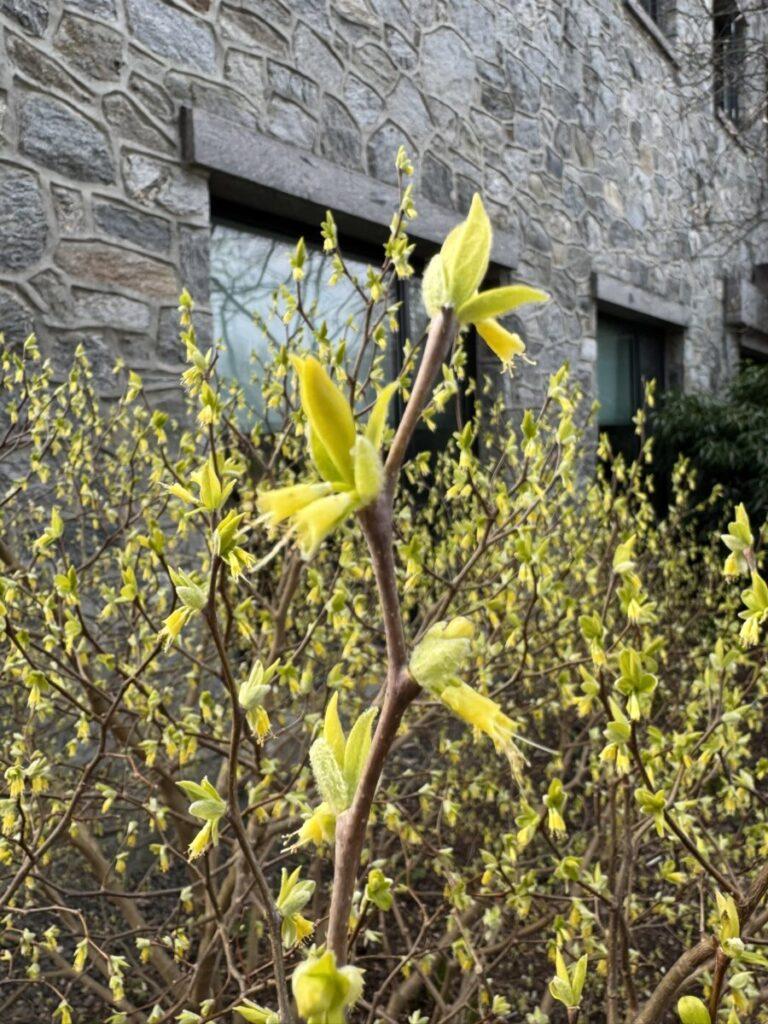
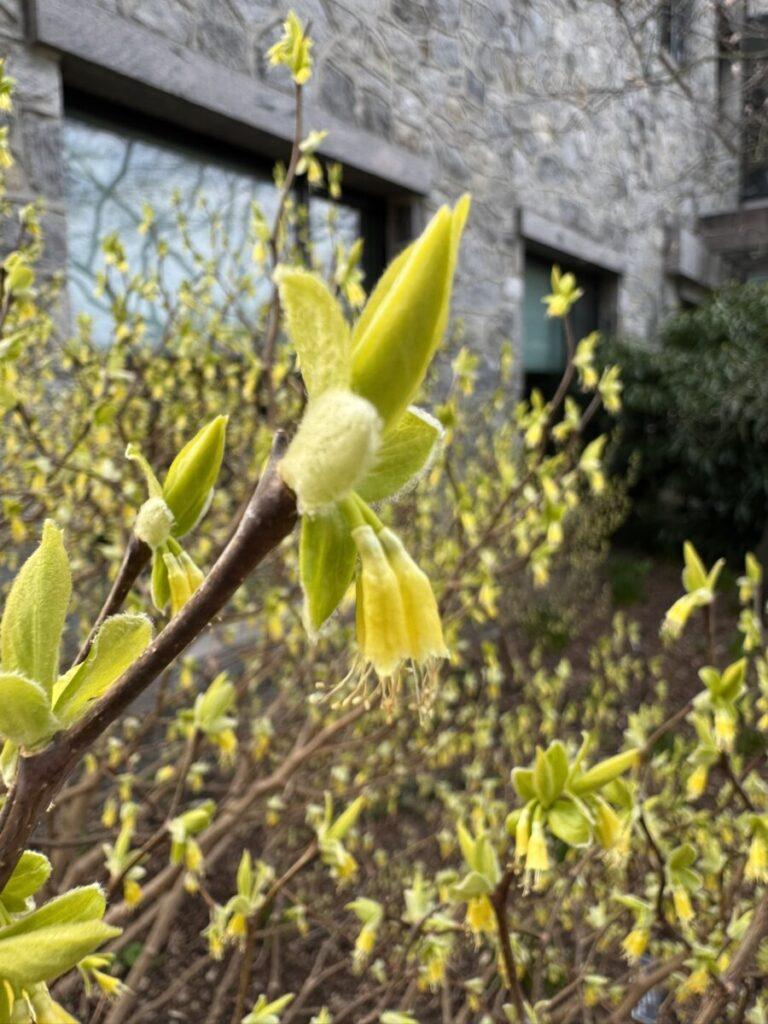
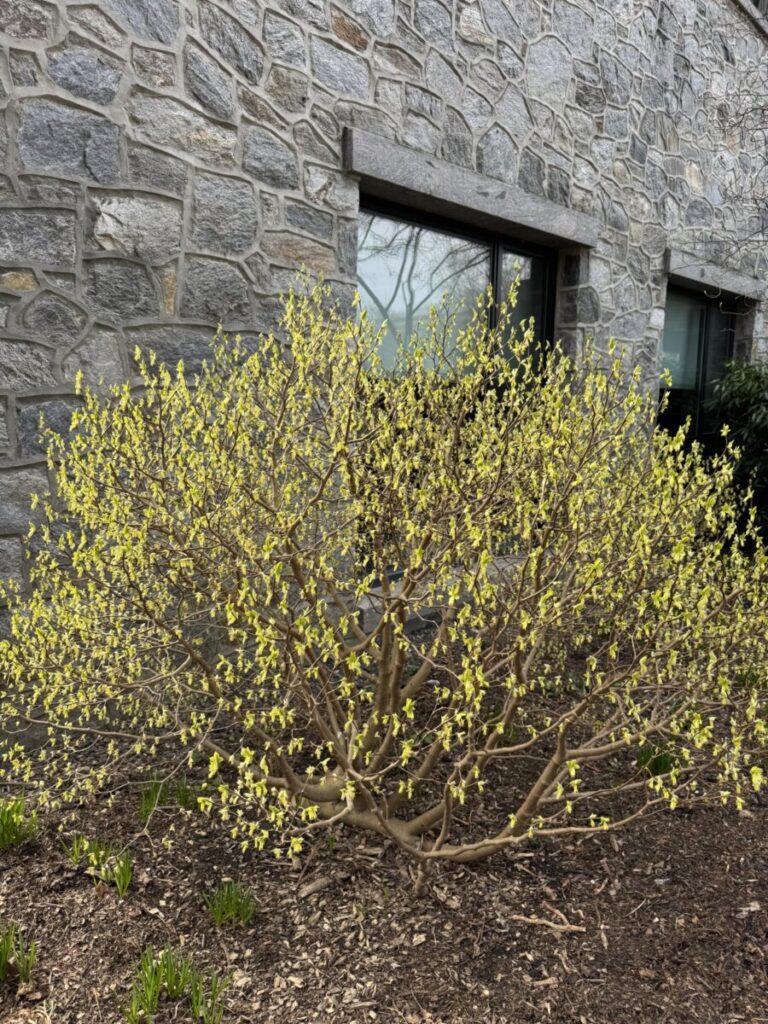
A somewhat uncommon shrub, Dirca palustris is Northeastern America native that puts on a show of yellow from mid-March to early April. Although the blooms do not last very long, Leatherwood has other features that make it a worthy substitute for Forsythia. The blooms are small, tubular, and pale yellow — so subtle that you could walk right past them if you are not paying attention. They appear in tight clusters along the stems before the leaves emerge, and while they will never compete with Forsythia for roadside impact, they have a quiet beauty that rewards the observant gardener
Ethnobotanical Interest
Although this yellow spring flowering shrub does not bloom very long, Leatherwood has other features that make it a worthy addition to the spring garden. I love the emerging leaf puppies right after the bloom period ends. And any plant that has more functions than just aesthetics is a winner in my book. The stems are remarkably pliable — you can tie them in a knot without snapping them. This unusual flexibility is what gives the plant its common name, and it has a long ethnobotanical history; Indigenous peoples of eastern North America used the bark to make cordage and lashings. It is one of those botanical details that makes a plant memorable long after the flowers have dropped.
Seasonal Interest
But what draws me to Leatherwood beyond its yellow spring flowering shrub early blooms is the bark. The smooth, brown bark has a lustrous quality that is genuinely beautiful in winter — it practically glows on an overcast January afternoon. Combined with a graceful, rounded habit (no need to sheer this one into a meatball) that reaches about five to six feet in maturity, Leatherwood is one of those shrubs that earns its place in the landscape twelve months of the year.
And let us not overlook the fall color. Leatherwood turns a clean, warm golden yellow in autumn — not brassy, not range-tinged, just a pure, luminous gold that pairs beautifully with the tans and russets of the late-season woodland garden. Forsythia fall color, by contrast, is forgettable at best or in most cases non-existent.
As a native plant, Dirca palustris fits naturally into ecological landscapes and native plant gardens. It is an understory species, perfectly adapted to the dappled shade beneath deciduous canopy trees. It will not thrive in full sun and dry soil, so think of it as a woodland companion rather than a Forsythia substitute in the traditional sense. But for shaded properties — and there are plenty of those here in Southeastern PA — Leatherwood is a gem hiding in plain sight.
3. Cornelian Cherry
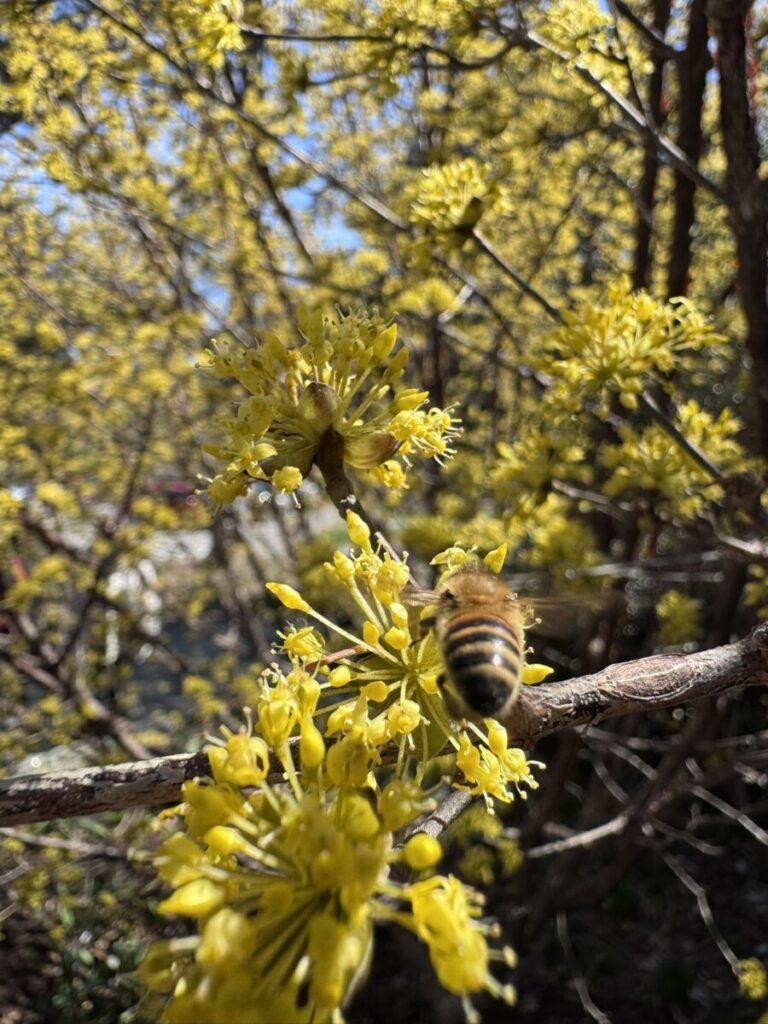
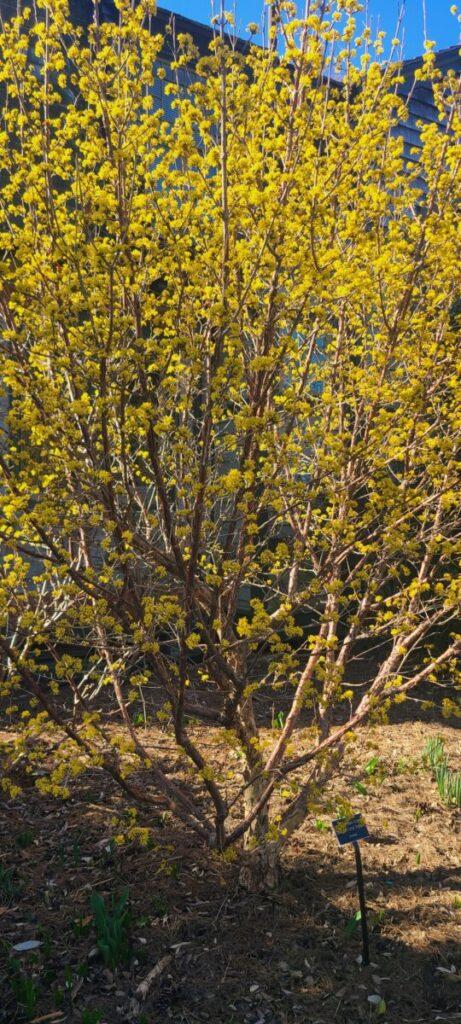
Now we move from shrubs into small tree territory, and Cornus mas is where things get exciting. Cornelian Cherry is one of the earliest woody plants to bloom in the Mid-Atlantic region, often opening its flowers in early to mid-March — a full two weeks before Forsythia even thinks about waking up. The blooms are dense clusters of tiny, bright yellow flowers that stud the bare branches, creating a golden haze that is every bit as eye-catching as Forsythia but with considerably more sophistication.
Cornus mas is a member of the dogwood family, and while it does not have the showy bracts of our native flowering dogwood, it more than compensates with its seasonal versatility. This is a true four-season plant: yellow blooms in early spring, clean dark green foliage in summer, bright red edible fruit in late summer, and handsome exfoliating bark that provides winter interest. The fruit, by the way, resembles a small olive and has a tart, cherry-like flavor that has been used for centuries in Eastern European cuisine for preserves, syrups, and even a fermented drink. If you have ever visited a farmers market in Serbia or Ukraine, you have likely seen them.
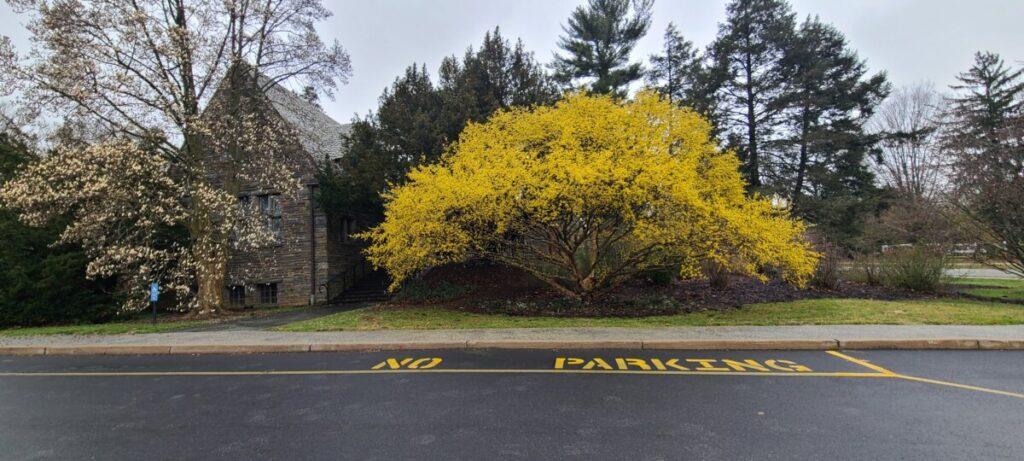
One cultivar that deserves special attention is Cornus mas ‘Spring Glow.’ This selection is a standout for its exceptionally heavy bloom, vigorous growth, and an upright habit that gives the tree a strong presence in the landscape even as a young specimen. If you are going to plant one Cornelian Cherry, ‘Spring Glow’ is the one I would recommend.
At maturity, Cornus mas develops into a large, multi-stemmed shrub or small tree reaching fifteen to twenty-five feet. The bark on older specimens flakes and peels to reveal a mosaic of tan, gray, and brown — subtle, but beautiful if you take the time to notice. It is tolerant of a range of soil conditions, handles full sun to part shade, and once established, is impressively drought tolerant. Unlike the Winter Hazels and Leatherwood, this is a plant that can actually handle the tough conditions where Forsythia typically gets planted. For a more detailed look at the Cornelian Cherry, please visit https://plantspeopleplaces.com/cornelian-cherry-cornus-mas/
4. Japanese Cornelian Cherry
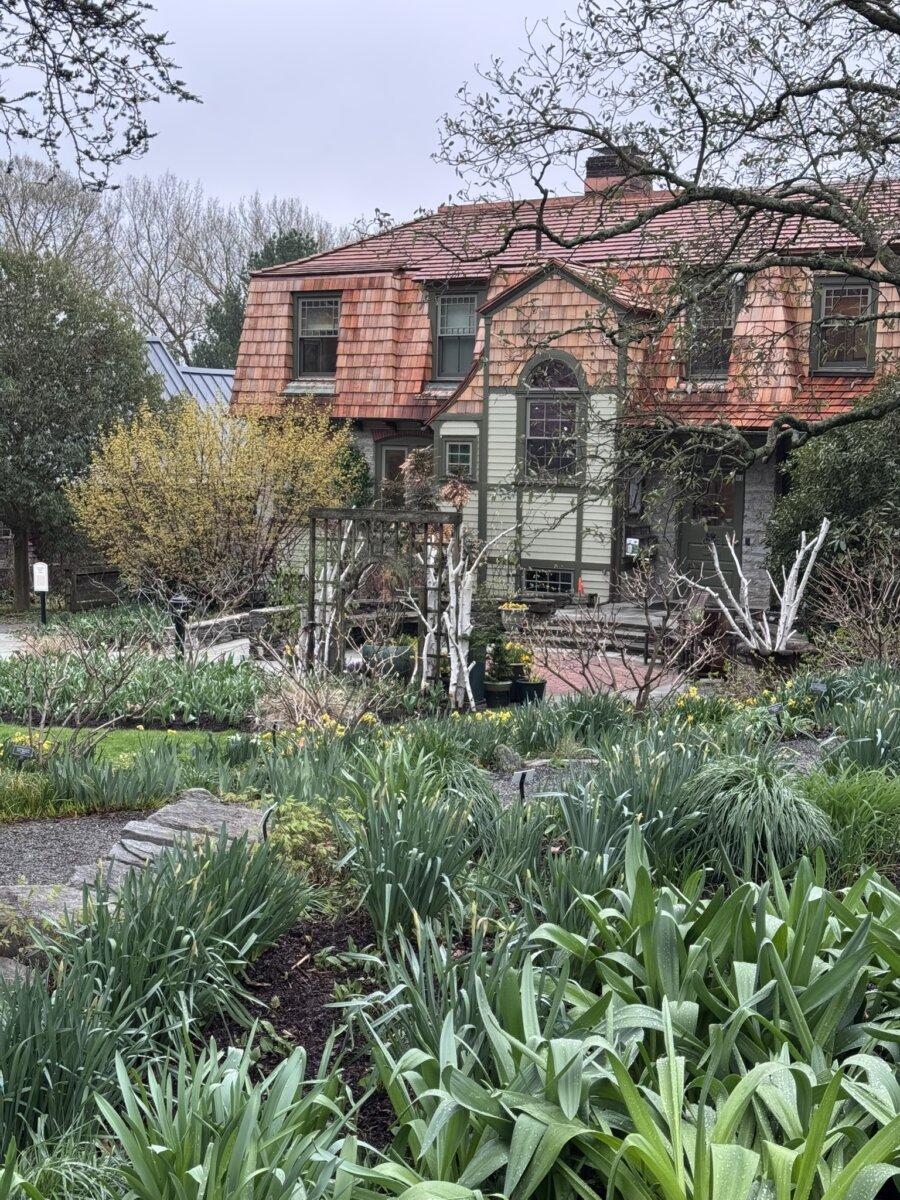
If Cornus mas is the bold elder sibling, then Cornus officinalis is the slightly smaller, slightly more refined counterpart. Japanese Cornel Dogwood blooms at roughly the same time — early to mid-March — and the flowers are virtually indistinguishable to the casual observer. Both produce dense umbels of small yellow flowers on bare wood, and both create that same golden haze effect in the late-winter landscape. Considering a perennial pairing? These dainty purple Iris with a yellow tongue will make an excellent early spring plant combination.
So why include both? Because the differences, while subtle, matter for garden design. From my own observations, Cornus officinalis tends to stay smaller in stature than C. mas, maintaining a tighter, more compact form as either a large shrub or modest small tree. This makes it a better fit for residential landscapes where a twenty-five-foot Cornelian Cherry might overwhelm the scale of the garden.
Where C. officinalis truly distinguishes itself, however, is in its bark. The exfoliating bark on mature specimens is more pronounced than that of C. mas, peeling in patches to reveal a rich patchwork of gray, tan, cinnamon, and orange. It is the kind of bark that makes you stop and run your hand along the trunk. In a winter garden, when everything else has gone dormant, a well-placed Japanese Cornel Dogwood is a sculptural presence that justifies its position in the landscape on bark alone.
The fall color on C. officinalis also tends to edge out its cousin, often developing richer tones of red and purple rather than the more muted fall display of C. mas. The fruit is similar — small, red, and edible — though C. officinalis fruit is used extensively in traditional East Asian medicine, where it goes by the name shan zhu yu and has been valued for centuries.
Closing Arguments
I want to be clear — I am not here to disparage Forsythia. It is a reliable, forgiving plant that has earned its place in the American landscape. But reliability alone should not be the only criterion when choosing plants for our gardens. The shrubs and small trees on this list offer something more: fragrance, bark interest, ecological value, edible fruit, and the kind of refined beauty that makes a garden feel intentional rather than default.
The challenge, as I mentioned at the top, is availability. Many of these plants are still underrepresented in the mainstream nursery trade. If you cannot find them at your local garden center, seek out specialty nurseries, contact your regional native plant society, or visit a public garden like the Scott Arboretum at Swarthmore College to see mature specimens in person. Once you see a Fragrant Winter Hazel in full bloom or run your hand along the exfoliating bark of a Japanese Cornel Dogwood, I suspect you will agree that the extra effort to source these plants is well worth it.
Spring is too short and too beautiful to settle for the same yellow every year.